
If your PulsaCoil has stopped supplying dependable hot water, record what has changed and arrange an assessment rather than guessing at the fault. An unexpected loss of hot water can disrupt washing, meals and your usual routine, so getting the right support matters.
A thermal store is a system that holds heated water to store energy and uses it to heat domestic hot water when needed. Symptoms can point to several possible problems, but they do not prove which part has failed. A qualified engineer needs to assess the unit before recommending repair.
Use this page to check local coverage, compare repair routes and prepare details that can help the service understand your situation. Enfield is in north London, but a nearby listing does not confirm that every address is covered or that an appointment is available at a particular time.
Keep the model name and a short description of the problem to hand before contacting a service.
Pulsacoil Repair Enfield: Booking a Local Visit
A local listing is a useful starting point, but the exact Enfield postcode still needs to be confirmed with the service. Gledhill PulsaCoil repair in Enfield starts with checking your address and model, rather than assuming a nearby listing guarantees attendance.
Local listings include addresses near Blackwell Close, Caspian Way and Meadowford Close, as well as a PulsaCoil engineer in Southgate. These locations can help you identify a possible route to support. They do not establish that the service covers your street or can offer a visit when you need one.
The London service lists the PulsaCoil 2000, PulsaCoil A Class, PulsaCoil BP, PulsaCoil Eco and PulsaCoil 3 among its models. Tell the booking team the model name shown on your PulsaCoil unit. If you are unsure, describe any label you can read without opening the appliance.
Have your postcode ready and explain what has changed. Say whether hot water has stopped completely, whether the display shows a light or error, and when the problem began. A clear account helps the service consider the right support route and whether the model falls within its stated coverage.
Share only details you can observe safely. You do not need to identify a failed part or interpret a display. If the hot water still works intermittently, explain when it works and when it does not. Mention any recent change in use or supply that may help the engineer understand the fault.
Before confirming a booking, ask whether your exact address is covered and what appointment options are available. Model coverage and visit availability should be confirmed directly, since a listing for a nearby road does not settle either point.
Ask who will attend and whether the engineer works on your particular model before agreeing to a visit.
What PulsaCoil Symptoms Should You Report?
No hot water can result from an immersion-heater, thermostat, pump or control problem, so the symptom alone does not identify the failed part. Several faults can create similar signs, and an engineer must assess the PulsaCoil unit before making a diagnosis.
When you describe the problem, focus on what you can see or experience. Report which of these symptom groups apply:
- No hot water, or hot water that has stopped altogether.
- Fluctuating temperature or reduced hot-water flow.
- A leak, including where you can see water collecting.
- Electrical tripping or lights shown on the display.
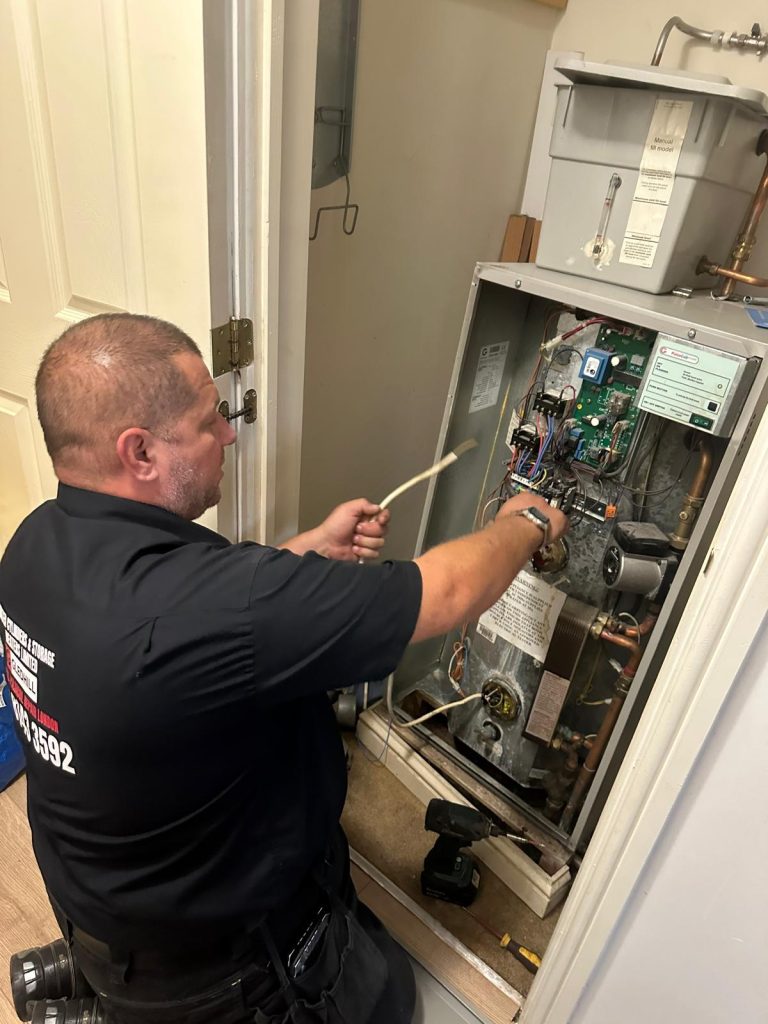
A PulsaCoil 2000 is a direct electric thermal store, not a conventional hot-water cylinder. It stores heat internally and uses a plate heat exchanger to heat incoming mains water as it passes through. Domestic hot water is supplied instantaneously through the exchanger and stabilises at approximately 55ºC.
Models other than PC125 have an on-peak boost that heats the top part of the store for one hour at a time. The PulsaCoil 2000 was manufactured between 2002 and 2005. Common reported faults include PCB faults, immersion-heater failures, thermostat issues, pump problems and scaling.
A flashing red light on an A-Class unit does not have one meaning across every version. On some early units, one flash per second can mean the store has cooled and may be reheated using the on-peak boost button. Later versions use slow flashing to indicate that the software believes an immersion-heater element has failed, though a burned-out power relay can cause the same indication.
Four flashes per second indicate detected overheating, but a control-board fault can also cause that pattern. The meaning depends on the model version and flashing rate, so report what you see rather than treating it as a confirmed diagnosis. A good A-Class immersion-heater element measures approximately 18 ohms. That is technical diagnostic information for an engineer, not a DIY test.
Give the engineer the exact light pattern and whether the unit still provides any hot water. If electrical tripping makes the circuit unsafe, stop using it and arrange a qualified assessment without opening the unit.
How Much Does a PulsaCoil Repair Cost?
The standard-rate option starts at £229.99 for the first hour, while the fixed-price option is listed at £399.99. Standard rates include VAT, with each following 15 minutes charged at £57.50 and parts and materials charged separately.
The Enfield standard repair listing gives the same rates. A fixed-price repair includes a 12-month parts-and-labour warranty, but you should establish what work and faults the quoted option covers. Do not assume a fixed price applies to every fault or to a unit that cannot be repaired.
Repair & Care is listed at £64.95 per month. A monthly plan is a different commitment from a one-off repair, so check its eligibility, scope, exclusions and contract terms. Ask when cover starts, which work is included and what conditions apply if the unit is irreparable.
Use the listed charges as a starting point for comparing repair options, not as a substitute for a written quote. Confirm whether the proposed work includes parts, labour and any follow-up visit. The amount you authorise should be clear before the engineer begins chargeable work.
| Option | Listed charge | What to confirm |
|---|---|---|
| Standard-rate repair | £229.99 first hour; £57.50 each following 15 minutes; parts and materials at cost plus 20% | Estimated labour, parts total and any extra work |
| Fixed-price repair | £399.99 | Work scope, eligibility and 12-month parts-and-labour warranty |
| Repair & Care | £64.95 per month | Eligibility, scope, exclusions and contract terms |
Ask for the price to distinguish labour from parts and materials. If diagnosis changes the proposed work, request an updated written total before authorising it. This gives you a clear record of what the charge covers and prevents a broad description from being mistaken for an agreed repair.
Keep the written quote and warranty terms, including any exclusions, before agreeing to the charge.
What Happens During a Repair Visit?
A repair visit normally begins with questions about the hot-water problem before the engineer inspects the unit. The engineer then explains the findings, the work proposed and the quote, so you can decide whether to authorise the repair.
The first visit is for assessment and work that can be completed with the available parts. Most repairs are estimated to take 1-3 hours, but that is not a promise that every fault will be fixed during the visit. The actual work depends on what the engineer finds.
A typical visit follows this sequence:
- Discuss your symptoms and confirm the PulsaCoil model.
- Inspect the unit and diagnose the fault.
- Explain the findings, proposed work and quote.
- Obtain your authorisation before carrying out the work.
- Test the unit and record the parts and work completed.
- Explain any next steps, including a possible return visit.
Take time to understand the proposed repair before you give permission. Ask what the quote includes and what would change it. The engineer should explain the diagnosis in terms you can follow, rather than expecting you to identify a component or approve work without a clear scope.
Some repairs need a return visit if the required spare part is unavailable or further diagnosis is needed. A longer repair can also result when the fault is more complex than first expected. The estimate of 1-3 hours can change with the work involved, so ask how the service will handle any extra time.
At the end of the visit, keep the diagnosis and any warranty paperwork with your records. These details can help if the unit develops a related problem or you need to check what the repair covered. Ask the engineer to record the work completed and the parts fitted on your paperwork.
How to Check PulsaCoil Engineers and Reviews
A useful review describes the model, the repair and the follow-up, rather than relying on a rating alone. A positive score can help you judge a customer’s experience, but it cannot confirm an engineer’s technical competence or guarantee an appointment.
For PulsaCoil repair in London, check whether the service covers your exact address and model. The London service describes coverage across Greater London and lists the PulsaCoil 2000, PulsaCoil A Class, PulsaCoil BP, PulsaCoil Eco and PulsaCoil 3. That model list is a starting point, not proof that every visit can be arranged.
Gledhill PulsaCoil repair in London should also be checked against the model label and your postcode. If a provider is based nearby, that alone does not tell you which engineer will attend or whether they regularly work on your unit. Ask for clear answers before you agree to a booking.
When reading Gledhill PulsaCoil repair reviews in London, look for details that help you compare service experiences:
- The model or type of PulsaCoil unit involved.
- What diagnosis the engineer gave.
- Which repair work was completed.
- How the provider explained costs and next steps.
- Whether aftercare or follow-up was described.
A review that names the model and describes the completed work is more useful than a score without context. Several detailed accounts may help set expectations about communication and aftercare, but they still cannot verify an individual engineer’s training or the parts available for your appointment.
Ask who will attend, which models they work on and whether suitable parts are available. Find out whether the diagnosis and quote will be explained before work begins. You should be able to understand the proposed scope before you decide whether to authorise it.
Ask the provider to confirm the attending engineer’s experience with your model before booking.
How Do PulsaCoil Stainless and Advance ETS Compare?
PulsaCoil Stainless and Advance ETS differ most in their delivery systems, electrical requirements and stated installation lead times. Their available capacities also differ, so neither model should be treated as a direct substitute without an installation assessment.
PulsaCoil Stainless uses an electronic delivery system with a PCB board, plate heat exchanger, sensors, pump and flow switch. Advance ETS uses a mechanical blending valve. Both are listed as compatible with smart controls, but their electrical and tank arrangements are not the same.
| Feature | PulsaCoil Stainless | Advance ETS |
|---|---|---|
| Available capacities | 150L, 180L, 210L | 160L, 210L |
| Cylinder, parts and labour warranties | 5-year sliding-scale cylinder; 1-year parts; 1-year labour | 10-year cylinder; 2-year parts; 1-year labour |
| Delivery system and required switches | Electronic system; 3 × 20amp double-pole switches | Mechanical blending valve; 2 × 20amp double-pole switches |
| Feed-and-expansion tank and filling | External tank, small sight glass; manual filling by jug | Internal tank, larger sight glass; built-in filling loop |
| Ordering-to-installation timing | 30 working days | 7-10 working days |
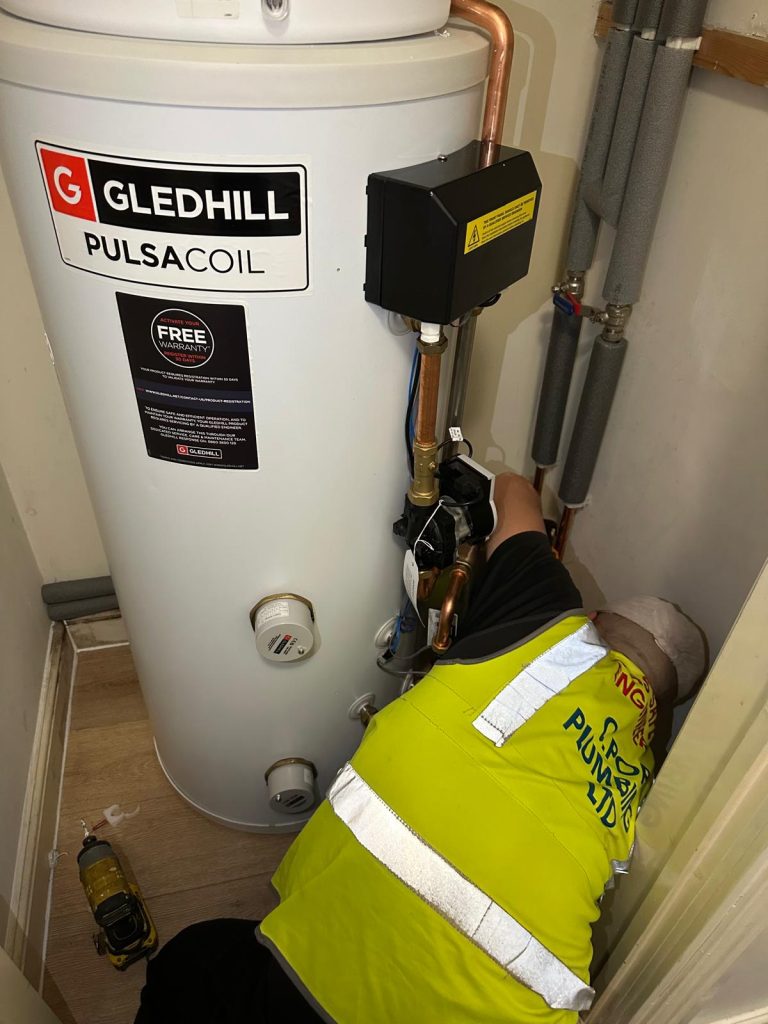
The PulsaCoil Stainless 210L has a black rectangular feed-and-expansion tank. That shape can help distinguish it from a white round tank when you check a proposed layout. Stainless models use an external feed-and-expansion tank, while Advance ETS has its tank inside the unit.
Listed customer ratings are 4.3 out of 5 from 630 reviews for PulsaCoil Stainless, and 4.4 out of 5 from 1,057 reviews for Advance ETS. These ratings provide context about customer feedback, not a prediction of performance in your home or evidence that one capacity suits your needs.
Ask the installer to confirm the proposed model, tank layout and warranty terms in writing.
When Should You Replace a PulsaCoil 2000?
Replacement becomes a stronger option when the cylinder itself cannot be repaired or suitable parts are unavailable, not simply because a valve or connection leaks. Repeated breakdowns or discontinued parts may also support considering a new unit, but a leak’s location matters.
A valve or connection leak does not prove that the internal cylinder has failed. An engineer can identify whether the fault is repairable and whether parts are available. If replacement is being considered, the right model and capacity depend on the property, household demand and existing connections.
Prepare these details for an installation assessment:
- Number of household residents.
- Usual hot-water consumption: low, average or high.
- How often you use showers and baths.
- Existing water connections and electrical supply.
- Available space for the unit and associated tank.
A thermal-store sizing guideline allows 35-45 litres per resident. Estimated daily hot-water use is 20-30 litres per person for low consumption, 30-50 litres for average use and 50-70 litres for high use. A shower uses about 18 litres at 40°C per minute, equivalent to 11 litres at 60°C. A bath uses about 100 litres at 40°C, equivalent to 60 litres at 60°C.
Under the stated consumption calculations, a standard four-person household requires a minimum 200-litre hot-water tank. These figures are guidance for an installer’s assessment, not a guaranteed fit for your home. The assessment should account for actual demand, connections and available space before a model or capacity is chosen.
Listed ordering-to-installation timing is 30 working days for PulsaCoil Stainless and 7-10 working days for Advance ETS. When a cylinder is not in stock, delivery to the installer usually takes 10-14 working days. Installation takes 3-5 hours, and an optional time clock costs £175.
Cylinders are delivered kerbside and require a two-person lift, so plan how the unit will be moved from the delivery point. Cancelling or postponing at least 24 hours before installation incurs no charge. Within 24 hours, a £199.99 call-out fee applies.
If a bespoke order is cancelled without rebooking within 7 days, 45% of the cylinder cost may be deducted. Have the installer confirm the size, connection changes, delivery arrangements and cancellation terms before paying for an order.
What Maintenance Can You Safely Do?
The safe routine check for a PulsaCoil 2000 is the water level in its plastic feed tank, not its internal electrical parts. The user guidance says to check the level 3-4 times a year and top it up to approximately halfway when needed.
This is an external check of the plastic feed tank, not permission to open the appliance. The PulsaCoil 2000 has no user-adjustable parts inside, and a suspected internal fault must be corrected by a competent person. Do not adjust internal components or attempt electrical repairs.
If the tank level needs topping up, follow the instructions for your model and do not reach into the appliance. If you cannot identify the feed tank or are unsure how to check its level safely, ask a competent engineer for guidance rather than removing a panel.
A maintenance visit or repair care plan may offer support, but its scope depends on the terms. Ask what checks, repairs and parts are included, and read the exclusions and conditions before signing up. Do not assume that regular maintenance prevents faults or guarantees hot water.
If the level keeps dropping or you suspect an internal fault, arrange a competent assessment.
Arrange an Enfield PulsaCoil Assessment
If your hot water remains unreliable, have the model and fault details ready when arranging an assessment. PulsaCoil Group can discuss an Enfield visit by phone on 0330 229 4190 or through its booking route.
Give the service your postcode, model and a brief description of the symptom. Before work is authorised, confirm the appointment details, written quote and warranty conditions. Make sure the proposed work and payable total are clear to you.
Call 0330 229 4190 to discuss a booking and confirm the terms before authorising work.